
Jordan Ziegler Talks Injury Benefits And Police Pensions On Suffolk County PBA Podcast
Why These Conversations Matter For Injured New York Officers And Workers
When a New York police officer gets hurt in the line of duty, the impact doesn’t stop with the immediate pain. A single incident can ripple through a career, a pension, and a family’s financial stability for decades. That’s why conversations about benefits, notice rules, and disability pensions aren’t just technical topics. They’re about how officers and other workers protect the lives they’ve worked so hard to build.
Recently, senior partner Jordan A. Ziegler joined the Suffolk County PBA’s “On Patrol” podcast to talk directly with officers about what really happens after an injury. As disability counsel to numerous police unions and chair of our firm’s Civil Service Disability Retirement Pension Department, Jordan brought the same courtroom-grounded clarity he uses every day for injured workers and first responders across New York.
At Pasternack Tilker Ziegler Walsh Stanton & Romano LLP, our firm was built to stand with hardworking New Yorkers, and conversations like this are one more way we help workers understand how to protect their benefits when everything is suddenly on the line.
How One Injury Can Trigger Multiple Benefits
One of the most important points Jordan emphasized is that a single line-of-duty injury can open the door to several types of claims at the same time. For civil servants, especially police officers and first responders, those benefits often overlap in ways that are easy to miss if you try to navigate everything alone.
From one incident, a New York officer may have potential rights to:
- Workers’ Compensation Benefits That Replace Lost Wages And Cover Medical Care: An injury that occurs while you’re working can qualify for workers’ compensation, which provides wage replacement and treatment, regardless of fault, if the claim is handled properly and filed on time.
- Salary Protection Under General Municipal Law For Certain Law Enforcement Officers: Officers covered by provisions such as General Municipal Law 207 can receive full salary instead of partial wage replacement, which can make the difference between staying afloat and falling behind.
- Personal Injury Claims Against Negligent Third Parties Who Cause Harm: If a non-coworker driver runs a red light and strikes a patrol vehicle, or a third party’s negligence creates a dangerous condition, that separate party may be held responsible through a personal injury lawsuit.
- Social Security Disability When An Injury Keeps You Out Of Work Long Term: If a condition prevents you from working for at least twelve months, you may also be eligible for Social Security Disability benefits in addition to state and local systems.
- Civil Service Disability Pensions For Permanent Job-Related Disabilities: When an injury permanently prevents an officer or civil servant from performing their duties, a disability pension can provide long-term, tax-advantaged income to help protect the officer's or civil servant's future.
The common thread in all of these paths is simple but unforgiving: if workers don’t understand their options early, they can unintentionally walk away from benefits they’ve earned over a lifetime of service.
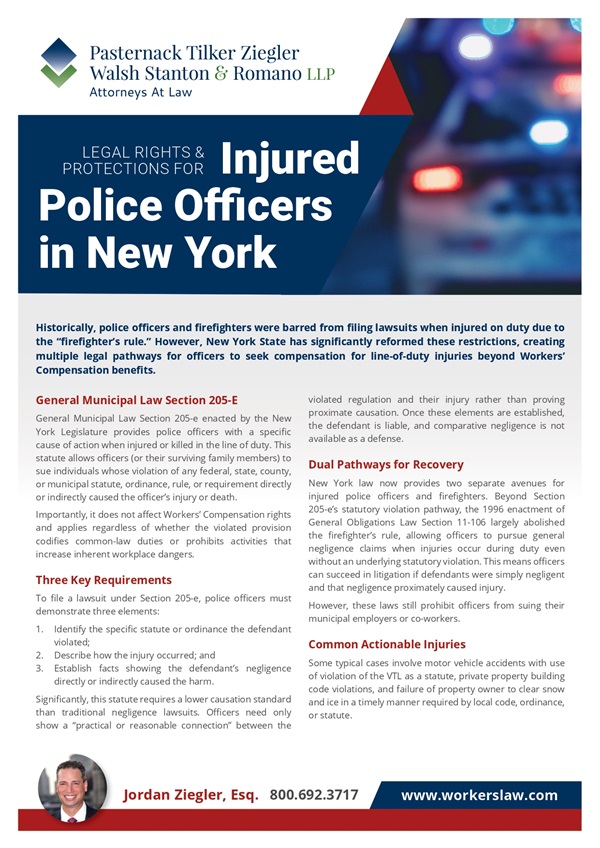
Why Notice And Early Reporting Are So Critical
Jordan spent a significant part of the podcast focusing on something that sounds basic but carries enormous legal weight: telling someone you were hurt and creating a clear record of what happened.
For New York workers, especially police officers and union members, early notice has several key functions:
- Protecting Workers’ Compensation Rights Through Timely Written Notice: State workers’ compensation law expects injured workers to notify their employer within a short statutory window, and written notice within 30 days is one of the cleanest ways to preserve those rights.
- Laying The Groundwork For Future Disability Pension Applications: Disability pension boards often turn back to those early reports years later to decide whether an injury truly occurred in the line of duty and whether it should be treated as work-related.
- Reducing Disputes About Where and How an Injury Occurred: The sooner the incident is documented, the harder it is for insurers or agencies to argue that the injury came from somewhere else or from an unrelated event.
Even when an internal department policy sets a three-day reporting rule, Jordan reminded listeners that legal standards are different from internal codes. A worker who misses an internal deadline may still have strong workers’ compensation and disability pension rights, but only if they get proper legal guidance and act quickly.
The bottom line is simple. When you’re hurt at work in New York, notice is the first bridge to every benefit you may later need to cross.
How A Few Words In Your Report Can Affect Your Pension
One of the most eye-opening parts of Jordan’s conversation with the Suffolk County PBA was his explanation of how language choices in early reports can influence civil service disability pensions. The system often focuses less on how serious the injury looks in medical records and more on how the incident is described on paper.
Jordan explained that, especially for law enforcement officers, there’s often a practical distinction between:
- Routine Physical Actions That Sound Inherent To The Job: Phrases like lifting, bending, pushing, pulling, or twisting often read as the everyday physical demands of police work or other labor-intensive jobs. Those descriptions frequently align with lower-level disability pensions, even when the injury is severe.
- Sudden Events That Signal An Unusual Hazard Or Outside Force: Words like assaulted, crashed, stabbed, or struck convey that something unexpected happened, whether it was a violent encounter, a hidden defect, or a third-party driver causing a collision. Those narratives can strengthen the case for higher-level disability pensions.
Jordan also stressed that officers and workers should always tell the truth, but they shouldn’t leave out important context. Writing “slipped on wet leaves” tells one story. Writing “on a warm, dry night, while performing my assigned duties, I unexpectedly stepped onto a hidden patch of wet leaves on a stair and fell” paints a clearer picture of why the hazard wasn’t something you could reasonably anticipate.
For many New York officers, that level of detail can become the difference between a pension that feels fair and one that falls short of what the law intended.
The Heart Bill, Long Term Health, And Filing Deadlines
Jordan also walked the Suffolk County PBA audience through an issue that weighs heavily on many officers nearing retirement age or living with heart disease: the New York heart bill for certain law enforcement officers.
He explained that the heart bill creates a legal presumption that qualifying heart conditions in covered officers are work-related, so long as the condition meets the statutory standards. The presumption helps shift the burden away from the officer, but it doesn’t automatically guarantee a higher pension. Workers still have to show that their heart disease actually disables them from continuing in their duties.
One critical point Jordan highlighted is the timing rule. Heart bill disability applications generally must be filed while the officer is still on payroll, not after they submit ordinary service retirement papers. That timing requirement catches many officers off guard, especially when they think they’ll “just retire” and deal with health issues later.
Our attorneys see firsthand how hard it can be to step away from a career in law enforcement, but we also know how important it is to match the timing of a heart bill application to both medical reality and statutory deadlines. When those pieces line up, families have a stronger chance of securing the long-term income they need.
Why Uninsured Motorist Coverage Should Matter To Every Officer
Toward the end of the podcast, Jordan shifted from formal pension rules to something every driver should review at home. When a patrol vehicle is struck by a negligent driver with little or no insurance, there’s a real risk that the officer’s injuries won’t be fully compensated by the at-fault party’s policy.
That’s where uninsured and underinsured motorist coverage on a private auto policy can play a huge role:
- It Helps Close The Gap When The Other Driver Has Minimal Coverage: If the at-fault driver carries only a basic policy, a serious injury can quickly exhaust those limits, leaving the injured officer looking for other sources of recovery.
- It Can Protect You Even When You’re Driving A Patrol Vehicle: In many situations, uninsured motorist protection attached to your personal policy at home can still provide benefits after a crash in a police vehicle, subject to policy terms and New York law.
- It’s Often Some Of The Most Affordable Auto Insurance You Can Add: In Jordan’s experience reviewing policies, the cost of increasing uninsured motorist coverage is usually far lower than people expect, especially compared to the potential benefit if a catastrophic crash occurs.
Our firm consistently encourages New York workers to review their own coverage with a careful eye, because smart choices at home can make a real difference after a collision on duty or off.
A Law Firm That Shares The Values Of The People We Represent
Jordan’s appearance on “On Patrol” also touched on something deeper than statutes and claim forms. As disability counsel for multiple police associations, as a board member of organizations such as Ronald McDonald House Metro New York and the Atlantic Marine Conservation Society, and as an active participant on occupational health boards at Northwell and Mount Sinai, Jordan has devoted his career to standing with workers, families, and communities.
That sense of service reflects the broader mission of Pasternack Tilker Ziegler Walsh Stanton & Romano LLP. For more than 90 years, our firm has fought for injured workers, first responders, union members, and civil servants across New York. We see how much they give to this state every day, and we believe their benefits, pensions, and legal rights deserve the same level of dedication.
Proudly Representing New Yorkers Who Put Their Lives On The Line
When an injury, illness, or heart condition threatens your career, you shouldn’t feel like you’re walking into a maze alone. You deserve experienced guidance from attorneys who understand how these systems really work and who are prepared to stand up for you at every stage of the process.
If you’re a New York police officer, first responder, union member, or injured worker with questions about workers’ compensation, civil service disability pensions, or long-term benefits, our firm is here to listen, explain your options, and fight for the meaningful results you and your family need to move forward. To learn more about how we can help you, contact us today for a free consultation.
"They kept me informed, always able to speak with someone every time I reached out to them. VERY satisfied with their work." - Ronell D., ⭐⭐⭐⭐⭐